For global cocoa importers and industrial buyers, sourcing strategy is changing.
The world's chocolate, confectionery, food and beverage industries require increasingly reliable access to cocoa beans, while buyers are simultaneously facing higher expectations around origin diversification, traceability, sustainability, quality consistency and supply-chain transparency.
While West Africa remains the dominant global cocoa-producing region, Uganda and the wider East and Central African region are emerging as strategically interesting sourcing origins.
Uganda offers international buyers a growing cocoa supply base supported by expanding farmer networks, increasing production, established export channels and significant potential for productivity and quality improvement.
At the same time, neighboring and nearby origins — particularly the Democratic Republic of the Congo (DRC) and Tanzania — create opportunities to develop broader regional sourcing programs.
For international industrial buyers, the opportunity is therefore not simply to purchase Ugandan cocoa.
It is to build diversified, traceable and commercially scalable cocoa supply chains from East and Central Africa.
Why Uganda Matters to Global Cocoa Buyers
Uganda's cocoa industry has expanded considerably in recent years.
According to Uganda's Ministry of Agriculture, cocoa production reached approximately 51,678 metric tonnes in 2023/24, compared with approximately 38,570 tonnes in 2019/20. Cocoa export revenue also increased significantly, reaching approximately US$215 million in 2023/24.
Ugandan cocoa is already integrated into international markets, with exports reaching both Asian and European buyers.
For global procurement teams, this creates an important opportunity:
Uganda provides an emerging origin that can complement traditional cocoa sourcing strategies.
Rather than replacing established origins, Ugandan cocoa can contribute to a broader procurement portfolio designed to reduce geographical concentration and strengthen long-term supply resilience.
Uganda: An Emerging Commercial Cocoa Origin
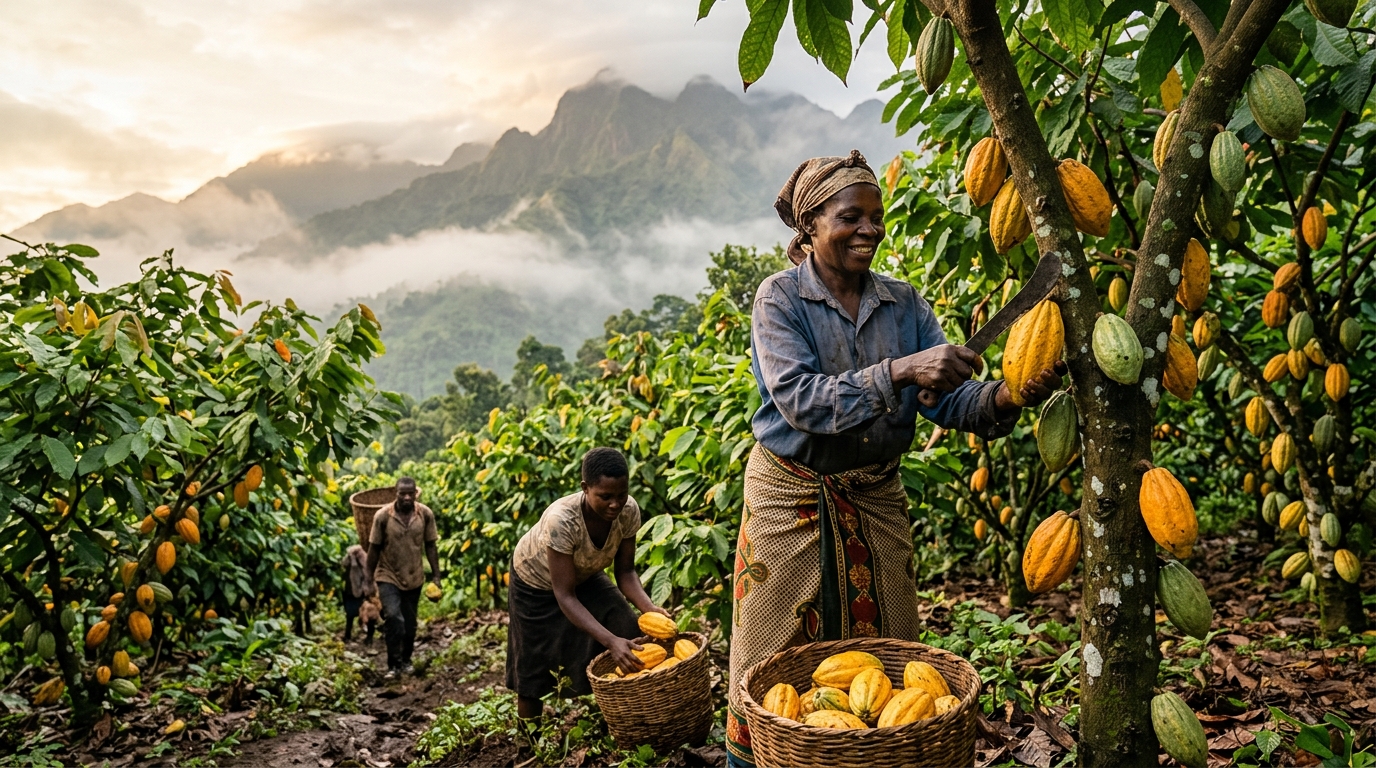
Uganda's cocoa production is primarily based on smallholder farmers, with important production areas including:
The Bundibugyo and Rwenzori areas are particularly associated with Uganda's cocoa industry.
The expansion of cocoa cultivation into additional agricultural regions creates opportunities for international buyers and exporters to develop multi-region procurement programs.
For industrial buyers, the commercial potential lies in combining:
Farmer networks + aggregation + quality control + traceability + export logistics
into a consistent international supply chain.
What Global Industrial Buyers Are Looking For
International cocoa procurement is no longer based exclusively on price.
Large industrial buyers increasingly evaluate suppliers according to a broader set of criteria:
Supply Reliability
Can the supplier provide consistent volumes over multiple shipment cycles?
Quality Consistency
Can beans meet agreed specifications for moisture, fermentation, bean count, defects and other quality parameters?
Traceability
Can the buyer identify the origin of the cocoa down to farms, cooperatives or defined production areas?
Sustainability
Can the supply chain demonstrate responsible agricultural and environmental practices?
Documentation
Can the exporter provide the required commercial, technical and compliance documentation?
Logistics
Can the supplier reliably move cocoa from producing regions to international ports?
Scalability
Can supply increase as the buyer develops a long-term sourcing program?
Uganda has the potential to address these requirements, particularly through continued investment in farmer organization, post-harvest handling, digital traceability and export infrastructure.
East and Central Africa: Beyond a Single Origin
A major opportunity for international buyers is to view Uganda within a wider regional sourcing strategy.
The surrounding region includes several agricultural economies with varying levels of cocoa production and commercial development.
Uganda
The principal focus and an increasingly important cocoa origin.
Democratic Republic of the Congo
An emerging cocoa origin, particularly in eastern DRC, with opportunities for specialty, certified and impact-oriented cocoa.
Tanzania
A smaller but established cocoa origin with access to international markets and Indian Ocean logistics.
Rwanda
A strategically important Great Lakes agricultural and commercial market, although cocoa production remains limited.
Burundi
A smaller agricultural economy where cocoa is not yet a major export crop, but which forms part of the broader Great Lakes sourcing ecosystem.
Kenya
A major East African commercial and logistics economy, although cocoa production remains small compared with its coffee, tea and horticulture sectors.
This regional perspective allows international buyers to distinguish between primary cocoa origins and supporting commercial and logistics markets.
The Uganda–DRC–Tanzania Opportunity
For international industrial buyers seeking additional African supply, a regional procurement strategy could combine selected origins according to:
Available volume
Bean quality
Harvest timing
Certification
Traceability
Logistics
Buyer specifications
Price competitiveness
Uganda can serve as the core sourcing origin, while selected supply from DRC and Tanzania can provide additional diversification.
This approach can help buyers develop a more resilient procurement portfolio rather than depending excessively on one country or production region.
From Commodity Trading to Structured Supply Chains
The future of cocoa sourcing is moving from simple spot transactions toward structured supply-chain relationships.
For global industrial buyers, a long-term sourcing program can include:
Farmer sourcing
↓
Cooperative and aggregation management
↓
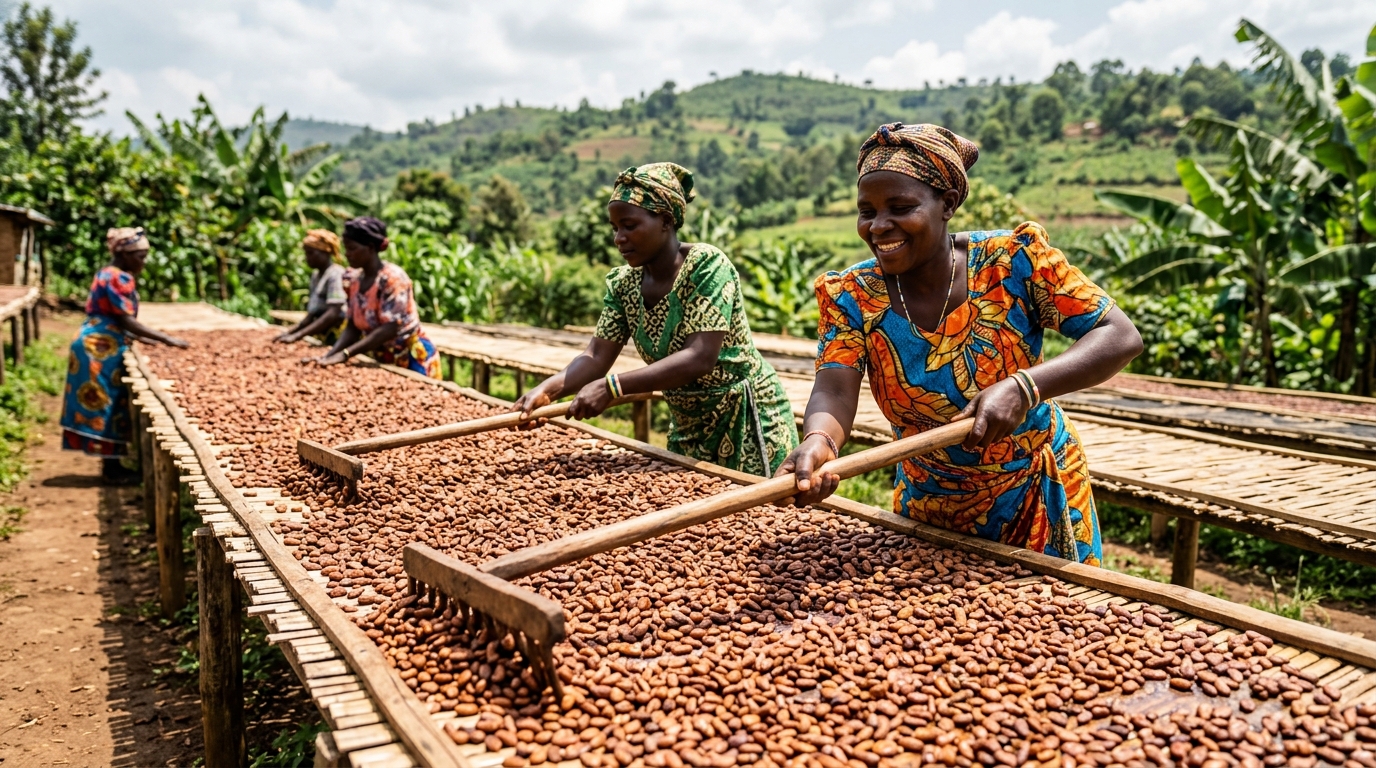
Fermentation and drying
↓
Quality control
↓
Digital traceability
↓
Warehousing
↓
Export documentation
↓
International logistics
↓
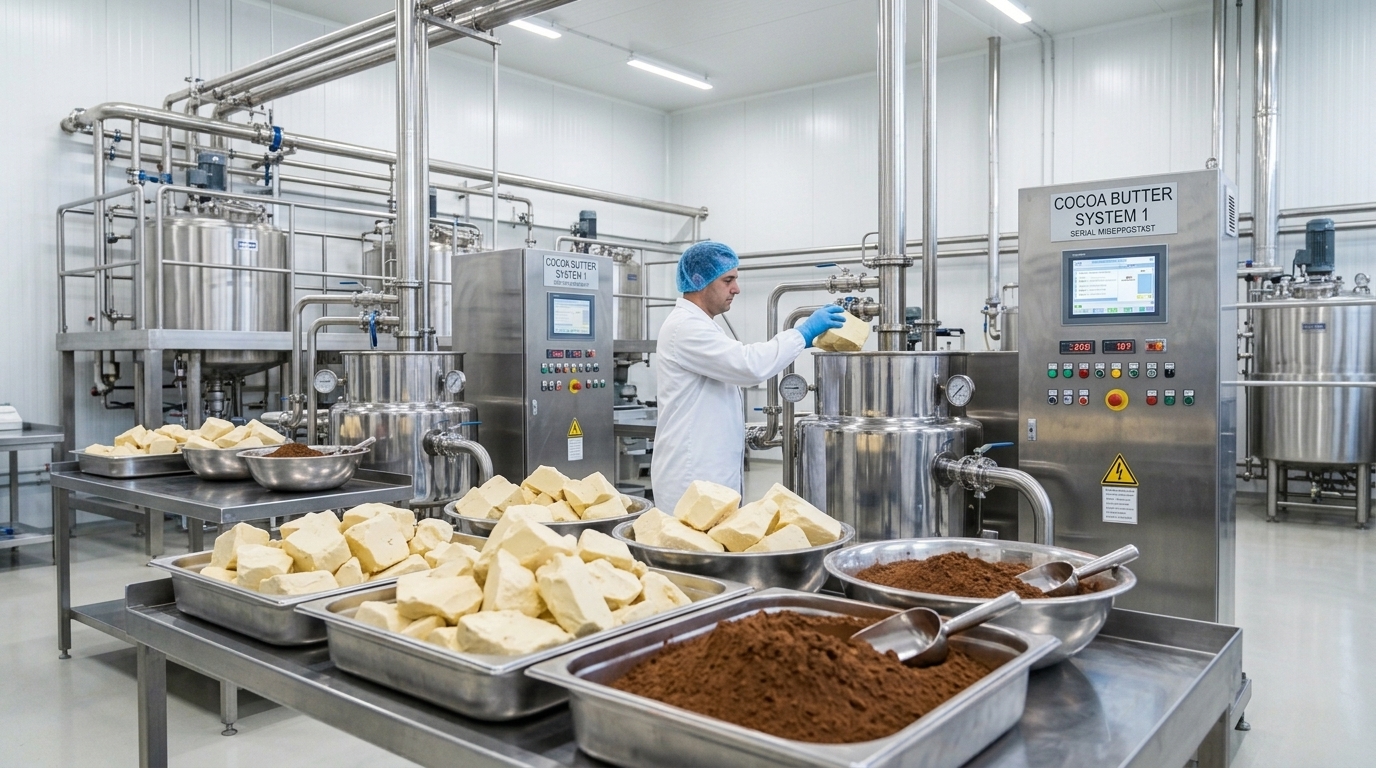
Industrial processing
This integrated approach gives buyers greater visibility over the product before it reaches the factory.
Traceability and EUDR Readiness
For companies supplying the European market, traceability has become a strategic procurement issue.
The EU Deforestation Regulation (EUDR) has significantly increased the importance of demonstrating the geographical origin of agricultural commodities, including cocoa.
Modern cocoa supply chains increasingly require information such as:
Farm or plot location
Geographic coordinates
Farmer or producer information
Supply-chain records
Production areas
Land-use information
Deforestation-risk assessment
Supporting compliance documentation
For Uganda and the surrounding region, building these capabilities represents more than a compliance requirement.
Traceability can become a competitive advantage.
Exporters capable of providing reliable farm-level information and transparent supply-chain documentation can become more attractive partners for multinational buyers.
Quality Is the Foundation of Industrial Supply
For cocoa grinders and industrial manufacturers, consistency is critical.
Industrial buyers need cocoa that can be incorporated reliably into their production processes.
Important commercial parameters can include:
Moisture
Bean count
Fermentation
Slaty beans
Moldy beans
Insect-damaged beans
Foreign matter
Bean size
Odor
Flavor profile
Packaging
Storage conditions
Lot traceability
The development of Uganda's cocoa sector therefore depends not only on increasing production, but also on improving post-harvest quality and consistency.
Investments in fermentation, drying infrastructure, farmer training and quality-control systems can create substantial value for both producers and international buyers.
Opportunities for Cocoa Grinders
Ugandan and regional cocoa can be relevant to industrial grinders seeking to diversify their African sourcing portfolios.
Potential industrial applications include:
For grinders, origin diversification can create opportunities to optimize bean procurement according to quality, price, availability, flavor characteristics and processing requirements.
Long-term relationships with origin suppliers can also provide greater visibility over future supply.
Opportunities for Chocolate and Confectionery Manufacturers
Chocolate manufacturers increasingly need reliable cocoa sourcing while responding to consumer expectations around:
Uganda offers the possibility of developing cocoa programs that combine commercial supply with measurable sustainability and farmer-development objectives.
For premium and specialty manufacturers, traceable lots from defined Ugandan production areas can also provide opportunities for differentiated origin storytelling.
Opportunities for Food & Beverage and Ingredient Industries
Cocoa is not limited to traditional chocolate manufacturing.
International industrial demand extends across:
Food ingredients
Bakery
Biscuits
Dairy products
Ice cream
Cereals
Nutrition products
Beverages
Cocoa-based fillings
Confectionery
Foodservice
This creates multiple potential markets for African cocoa and cocoa-derived ingredients.
As regional processing capacity develops, there may also be increasing opportunities to move beyond raw bean exports toward semi-processed and higher-value cocoa products.
Building a Scalable Procurement Model
For a global buyer, the objective should not simply be finding a supplier for one shipment.
The greater opportunity is to establish a repeatable procurement system.
A scalable Uganda cocoa program can be structured around:
1. Origin Development
Identify producing regions, farmers and cooperatives.
2. Aggregation
Consolidate production into commercially meaningful lots.
3. Quality Management
Standardize fermentation, drying, grading and storage.
4. Traceability
Digitally map and monitor the supply chain.
5. Compliance
Prepare documentation required by international markets.
6. Logistics
Build reliable transport and export routes.
7. Long-Term Contracts
Develop predictable relationships between origin suppliers and international buyers.
8. Continuous Improvement
Use production and supply-chain data to improve quality, productivity and sustainability.
Why Global Buyers Should Consider Uganda Now
Uganda's cocoa industry is still developing.
For some buyers, this creates an advantage.
Early engagement can allow international companies to participate in building supply chains rather than simply purchasing from an already mature commodity market.
Potential advantages include:
Origin diversification
Growing production
Access to smallholder supply
Long-term sourcing potential
Regional supply opportunities
Traceability development
Sustainability programs
Potential for quality improvement
Opportunities for value addition
The key is to approach Uganda not as a short-term trading opportunity, but as a strategic origin-development opportunity.
Uganda Cocoa: A Strategic Opportunity for Global Procurement
The global cocoa industry will continue to require large volumes of reliable raw material.
However, future procurement will increasingly depend on more than volume.
The successful cocoa supply chains of the future will combine:
Reliable Production
→ Consistent Quality
→ Traceability
→ Sustainability
→ Efficient Logistics
→ Regulatory Compliance
→ Competitive Commercial Terms
→ Long-Term Partnerships
Uganda has the potential to develop along this path.
Combined with selected supply opportunities from DRC and Tanzania, the country can become part of a broader East and Central African sourcing strategy for international cocoa buyers.
For global importers, grinders, chocolate manufacturers, confectionery companies, food manufacturers and commodity traders, this represents an opportunity to diversify sourcing, establish new origin relationships and participate in the development of the next generation of African cocoa supply chains.
Adalidda — Connecting African Cocoa Origins with Global Industry
Adalidda works with African agricultural supply chains to connect producers and exporters with international importers, industrial manufacturers, processors and commodity buyers.
Our cocoa sourcing strategy focuses on developing reliable supply from Uganda and selected East and Central African origins, according to buyer requirements.
We support international buyers looking for:
Ugandan cocoa beans
East and Central African cocoa
Long-term supply programs
Commercial-scale sourcing
Traceable supply chains
Sustainability-oriented sourcing
Customized quality specifications
International export documentation
Flexible packaging and shipment solutions
Available supply programs can be tailored to the buyer's specific requirements, including origin, quality, certifications, volume, shipment schedules, and destination markets.
For global importers and industrial buyers seeking to establish a reliable cocoa sourcing program from Uganda and the surrounding region, Adalidda can coordinate origin sourcing, supplier development, commercial negotiations, documentation, and international supply-chain execution.
We specialize in bulk cocoa supply programs starting from 25,000 MT per month.
Share your specifications with us, and let's build your next-generation cocoa supply chain together.
Uganda is more than an emerging cocoa origin.
It represents an opportunity to build the next generation of diversified African cocoa supply chains for global industry.
For further information, please contact us: